Agency and Adaptation
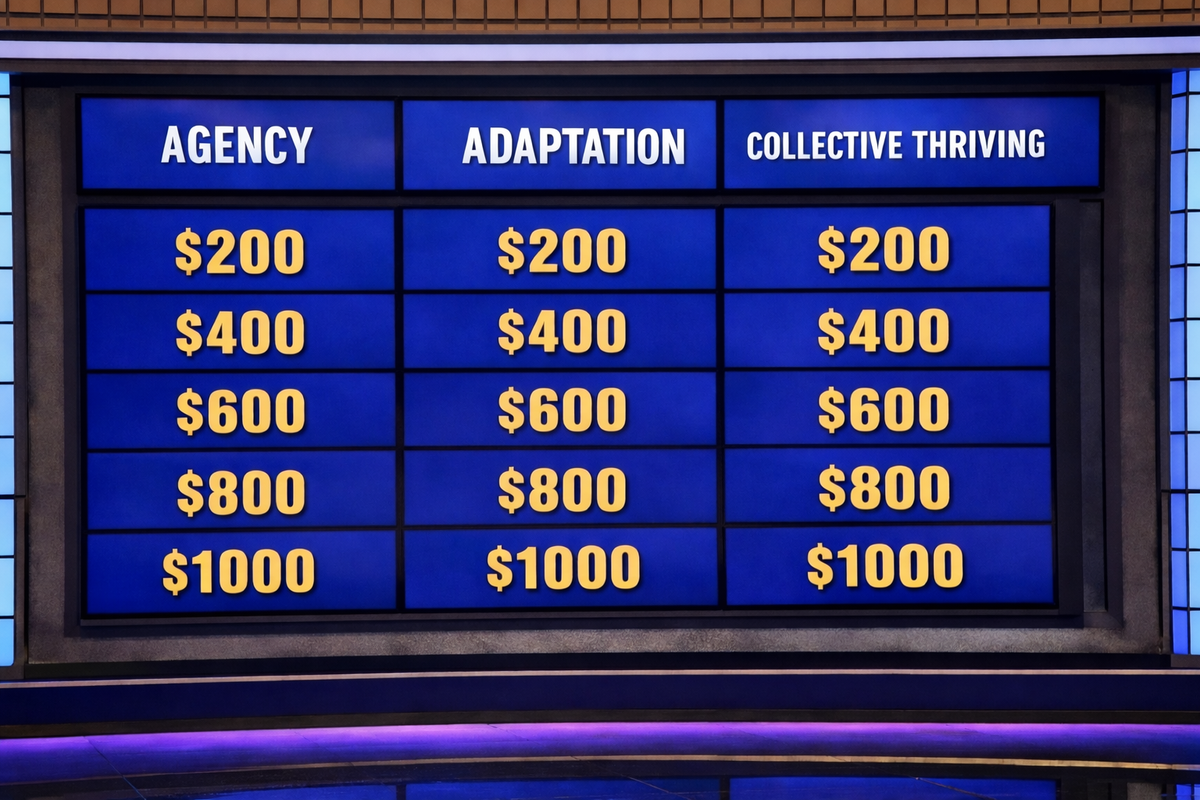
Question for leaders: Are you
A. Asking individuals to adapt to systems as they are (process, tech, role hierarchy)?
B. Considering and adopting individuals’ feedback about what in the system needs to change?
C. Combining A and B?
In the organizations I’ve known, the answer is always C. I might argue that all organizations enact (whether intentionally or unintentionally) C: some combination of asking individuals to adapt to existing systems and receiving their feedback.
However, leaders who answer “C” often offload the cost of adaptation onto individuals without redistributing power, resources, or accountability. This is the core issue. The conversation isn’t a simple matter of adaptation versus adoption, because it involves both. And neglecting the nuance of how individual adaptation and agency are combined is a matter of:
- Exclusion vs. inclusion
- Project failure vs. project success
- Individual prosperity vs. collective benefit
- Exhaustion vs. sustainability

From the outside, publicly available data makes this neglect clear. The indicators that follow reveal a reality many choose to ignore: organizations are failing to strike an effective balance between employee adaptation and agency, missing the mark on individual, collective, and societal benefit—and asking workers to bear the cost.
Let me explain.
- Exclusion vs. Inclusion: For those with employees, do you have any Glassdoor reviews, and have you taken the time to review them? They might mention how current (and often past) employees feel included at your organization. In addition to employee feedback, high-level statistics also speak volumes. Did you know that in the U.S., the labor force participation rate for people with disabilities is half that of people without disabilities? (42.6% vs. 77.9%). Discussing inclusion in organizations requires us to honestly and intentionally examine information like this and consider where we are falling short. These shortcomings are often a result of asking more of the individual than we are of the systems.
- Project Failure vs. Project Success: Think of projects that failed for lack of frontline input. A common one I see is in the adoption of an enterprise software system - countless hours and dollars are spent on choosing, modifying, updating, and “standardizing” the software system, but something is missing. Employees prefer older systems that worked better for their task needs.
While internal project success rates are not immediately apparent to an outsider, it’s important to note, and for those with a view into their organization’s project success, I challenge you to consider: Was feedback invited but constrained? Was the agency symbolic or real? In the segment of projects, we can observe how considering and/or including the voices of individuals, or the lack thereof, unfolds. - Individual Prosperity vs. Collective Thriving: In the U.S., publicly traded organizations are required to report the CEO pay ratio. If you are considering the collective benefit, these metrics are striking. According to the Economic Policy Institute, in 2025, the average CEO-to-worker pay ratio of the 350 largest firms was 281 to 1. Please take that in for a moment: On average, at the 350 largest publicly traded companies in the United States, the CEO of those companies earned 281 times more than the average wage of employees at that organization.
This is just one illustration (a financial one) of the pervasive imbalance between individual prosperity and collective benefit in U.S. organizations, where the top worker benefits exponentially more than the average worker. When 11% of Americans are living below the poverty line, and 4.4% are unemployed (and more than double that for Disabled Americans), it’s clear individual workers don’t have the say (read: agency) they should, and it shows. - Exhaustion vs. Sustainability: This may come as no surprise: employees are exhausted. According to Forbes, in 2025, 66% of American employees were found to be experiencing burnout. What if organizational leaders were to consider redesigning their systems to support the way their employees work, and trust individuals who advocate for their needs, rather than asking them to make a broken work system work? What would be the long-term benefits for productivity and organizational effectiveness?
If we really seek sustainability at an individual, organizational, and societal level, as a whole, organizational indicators point in every other direction than what is often claimed as valuable: Workplace inclusion, project success, collective benefit, and sustainable success and thriving (both collectively and individually).

And to me, it all comes back to a few important questions, one of which I posed at the beginning of this article, and I will ask it again:
Leaders, are you:
A) Asking individuals to adapt to systems as they are (process, tech, role hierarchy)?
B) Considering and adopting individuals’ feedback about what in the system needs to change?
C) Combining A and B?
I’d like to offer more insight into how to successfully combine asking individuals to adapt and receiving and incorporating their feedback in order to improve the system. Successfully combining these two things will be a matter of whether inclusion (some of which is actually required by law), successful execution, collective benefit (what we all really want), and the sustained thriving and success of all of us.
It might sound like a lot, but this is the real and important systems change work that needs to occur at the organizational level if we are to operate effectively.
In the coming months, I plan to post more about:
- Naming the hidden costs
- Inclusive systems and design
- Operations and practice: Agency and what “engaging” employees really might mean
While I have not directly named my new area of focus in this article yet (neuroinclusive operations and affirming work coaching), these are, in fact, deeply embedded in the experience of being asked to adapt versus being invited to be an agent of positive change. More on that to come, too.
If your organization is undergoing a process overhaul, system changes, job realignment, or is facing employee turnover, you are in a position to become more inclusive, effective, thriving, and good for everyone in the process. I invite you to book a complimentary discovery consultation to explore how I can help you achieve this goal.
What’s good for everyone is, in fact, good for everyone. Let’s find a way.
-Marissa Mosunich
Owner, Operate Well Consulting
www.operatewell.com