
Building Responsible AI Practices: Three Exercises for Your Organization

If you’re an organizational leader, you've probably been wondering how AI will change the landscape of your organization. Or perhaps you feel like it already is, and you haven’t quite gotten a grasp on it. Likely, your employees are wondering about this too.
One thing is clear: There is something deeply responsible about pausing to consider implications, opportunities, and guardrails when it comes to responsible use of AI in your organization. Further, for organizations that are particularly tuned in to social responsibility, anticipating the implications of AI use on the nature of work in your organization is fundamental. If you’re seeking to maintain ethical, human-centered work environments, I suggest that there is no better place to seek answers than from your own team.
Ask the questions, start the dialogue, and get mapping!
It’s likely that some team members are already using AI in ways leaders may not yet know, revealing both hidden liabilities and valuable opportunities. The below exercises are designed to catalyze meaningful conversations and build shared understanding. Adapt them to suit your needs, add columns if useful, and above all, create an environment where team members feel safe to share their ideas openly.
These exercises can spark conversations that guide your organization toward a bright future with AI, paving the way with intention as you consider current uses, risks, and opportunities together. Even the smallest steps can make a meaningful difference.
Exercise 1: Inquiry into Current Uses
Have team leaders organize weekly or biweekly 10–30-minute conversations with their teams about how they use AI. These conversations are best done with the whole team together and could be incorporated as part of a standing meeting.
Steps:
- Create a chart (paper or digital) with following columns:
-How We’re Using AI
-Risks & Benefits
-Opportunities: (If this is useful, how can we do more of it?) - Ask, “How have you been using AI so far?” List out what the team shares.
- Discuss and list out risks and benefits associated with that use. Ask, “Do you see any issues with the current usage?”
- Pose the question: “Do you see any opportunities associated with the current usage that you would like to explore further?” and jot down those ideas.
Example:
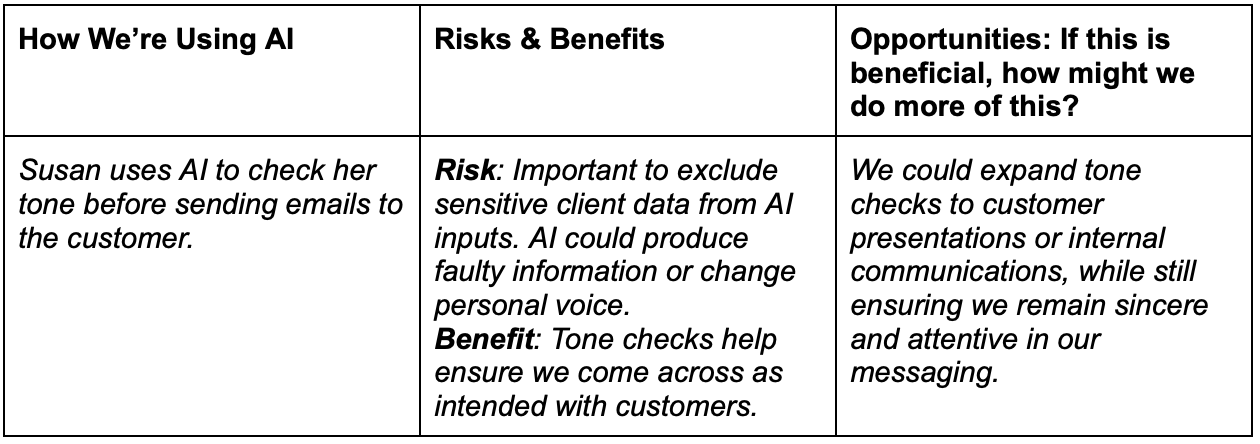
Tip: Psychological safety is essential for this exercise. Create an environment where team members feel safe expressing ideas without criticism. This exercise will also surface ways employees may be using AI that pose risks to the organization. Use these moments to start conversations about those risks, naturally leading into Exercise 2.
Exercise 2: Charting the Risks
Steps:
- Create a chart (paper or digital) with the following columns:
-Known AI Risk
-Policy/Mandate
-Q&A - In the “Known AI Risk” column, list out risks as they arise in conversation, including those that came up during Exercise 1.
- As a team, identify and list existing policies related to each risk in the “Policy/Mandate” column.
- In the “Q&A” column, note follow-up questions and answers. These questions will deepen your team’s learning and help identify policy considerations you may not have thought of before.
Example:
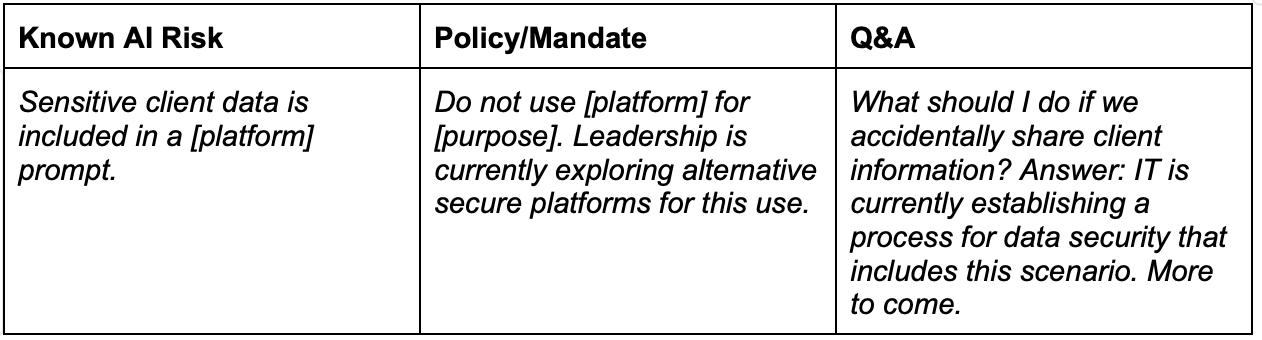
Tip: Even if your team doesn't have all the answers right away, keep the risk visible with a “more to come” note. This shows employees you are aware and committed to addressing it. Not only will this exercise provide clarity to team members, it will be important as decision makers get a better understanding of policies that are needed.
Exercise 3: Opening to Opportunities
Steps:
1. Create a chart (paper or digital) with the following columns:
-Ideas
-Stoplight Key (indicating leadership direction)
-Imagining Further: Have you tried this? Support or training needed
- Ask Prompt questions:
What ideas do you have for AI use at work?
What uses have you thought of but haven’t tried yet?
What would you like to learn more about? - Add employee ideas to the chart
- Indicate whether there is a need for caution when moving forward with this idea (you can use red, yellow, and green “lights”).
- In the “Application” column, take note of instances where people have tried this AI use, and note any questions have come up for them as part of that use.
- With the “Generative Questions” columns, encourage the team to take the idea further, asking questions like, “What other ways can you apply this idea in your day-to-day work?” “What tools may already exist?” “What are people in other organizations doing?”
Example:
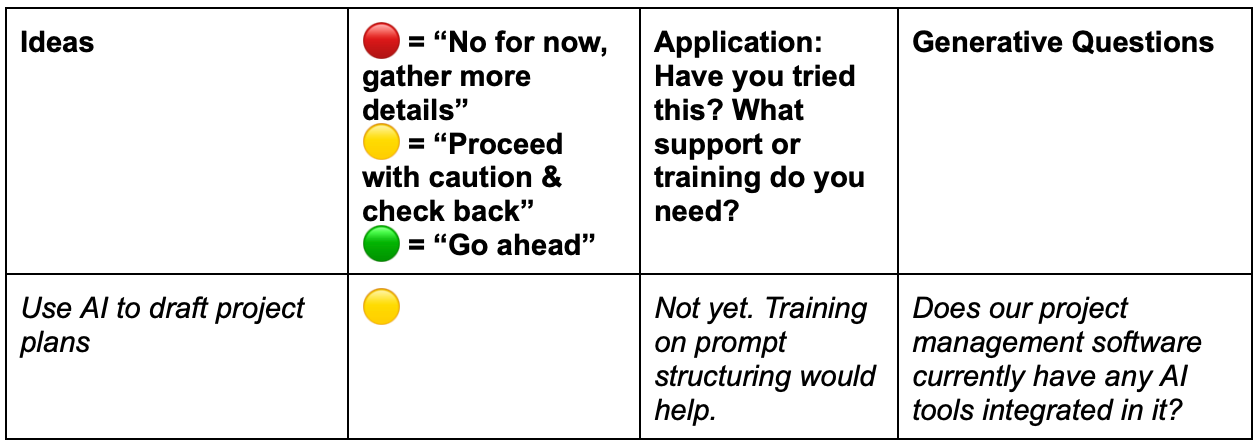
Tips: Add columns as needed to suit your project management or decision-making processes. Exercise 3: “Opening to Opportunities” is meant to be fun and generative. Encourage your team to think outside the box while balancing guidelines and limitations.
Conclusion
These exercises may be a great place for you and your team to start - or continue - to explore what working with AI looks like. In doing so, you will find that conversations naturally arise that will guide you and your team to a future with AI that looks brighter - not darker - for everyone. By pausing to consider opportunities, risks, and implications of working with AI at your organization, you are paving the future with intention. Even the smallest of steps will go a long way.
Engaging employees in these conversations as soon as possible will be your greatest asset in identifying risks and opportunities and shaping policies that ensure your organization remains effective, ethical, and ready to grow.
Operate Well is here to support you as you navigate the complexities of adopting AI, whether those adoptions are already happening or you’re preparing for what’s to come. Set up a complimentary discovery session to discuss more!
Copyright Operate Well, LLC 2025
AI Disclosure:
When writing this article, I used ChatGPT to:
Suggest clearer formatting for the exercise breakdown
Make suggestions for more concise phrasing